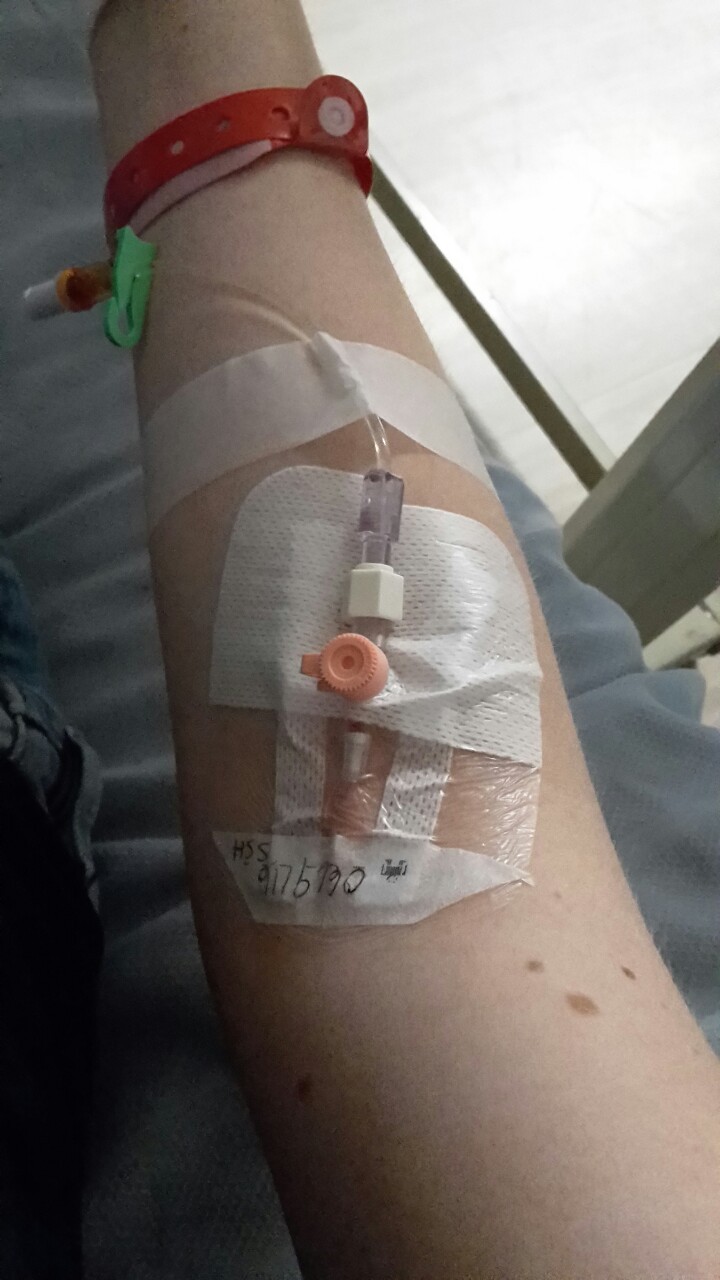
So, not much is happening so far. I’m back on the Addcal-d3’s and I’m on three bottles of fortisip each day as well as my mesalazine and mercaptopurine. They’re doing daily blood tests – which, at the moment, is a bit hard as my veins are being stubborn little things and not making it easy. I’m still on intravenous steroids but no news on when they are going to start my infliximab infusion. Also, the dietitian hasn’t been round yet so I’m hoping both will happen at some point today.
I’ve be prescribed Fortisip drinks for… nutrition, I guess; each 125ml bottle is 300 calories. Also, the infusion drug I’m starting soon is Infliximab. I’ll start the first infusion hopefully tomorrow, provided all my blood tests come back ok. They took another eight tubes of the stuff just now to make sure I don’t need any vaccinations before starting.
I’m trying to keep up on the water but they only give you a small jug every few hours so it might be hard to reach my Plant Nanny quota. Still, I’m sure I’ll be ok; it’s quite warm here in the UK at the moment so hopefully we’ll get extra water.
At a recent doctor’s appointment, I was shocked to hear myself say (after doing a little mental math) “I’ve had Ulcerative Colitis for 20 years.” Twenty years?! How can that be?? Once upon a time, 10 years was the benchmark I feared: after that, I needed checks every six months to make sure I hadn’t developed colon cancer. But now I’ve lived with this thing for twenty years. It’s meant at least three pills, three times a day, for 7,300 days. It’s meant backing away from a sport that I loved at the peak of my speed, missing important celebrations and time out with friends, forgetting details of Maya glyphs I’ve known for years, and many trips to the Emergency Room. For those of you who don’t know (or who, like some well-meaning supporters once did, describe UC as a disease that just gives you the “runs”), let me fill you in.
Ulcerative Colitis is an autoimmune disorder in which my immune system attacks the lining of my digestive system, like yours would attack a cold. It doesn’t recognize my own internal tissue as *me*: it thinks it is a foreign invasion, and tries to destroy it. This attack doesn’t stop with colon tissue – with the textbook symptoms of debilitating cramping, aching, and yes, those 10+ daily bathroom trips for the runs. When I’m having a flare, my skeletal joints swell and ache, become stiff and difficult to move. I vividly remember a flare in third grade – I missed weeks of school, and when I finally returned, symptoms at least somewhat in check, my knees and wrists hurt so bad that I couldn’t carry my school supplies, and I shuffled painfully, slowly toward my classroom. The bell rang, and the adult hall monitor approached, admonishing, and attempted to steer me to the front office to report me as tardy. Instead, I dropped my lunchbox, sat down in the hallway and sobbed. She wasn’t pleased. The tears stung – from embarrassment, yes, but also because my eye tissue was being attacked too, and they were already swollen, red, and stinging.
In college, I started showing new symptoms – vomiting, sharp stabbing pains under my rib cage, exhaustion, and jaundice. The doctors at Yale-New Haven broke the news: the bile ducts of my liver were now being attacked by my immune system, too. The technical term is “Primary Sclerosing Cholangitis”, and if you have UC, you have a 10% chance of developing PSC too. My liver enzyme levels were 8 times higher than normal when I was diagnosed, and unfortunately, there is no cure. There’s not even really a treatment – just a drug that may or may not do anything, but at least seems to do no harm. A liver transplant would certainly be in my future, but how far off no one could say.
PSC is very rare – and excluding us lucky UC patients, it’s MUCH more common in men over 50. When pain, unending vomiting, and yellow skin has sent me to the ER over the past 7 years, I’ve watched as nurses and doctors leave the room to look up the symptoms of PSC and its treatment. I resist when they are incredulous, or want to cover their own uncertainty – “are you sure it’s not just your gallbladder? You said you have trouble eating? Let’s do an ultrasound just in case you have a gall stone.” Sometimes I can convince them to bring in a liver or GI specialist, but most of the time I can’t stop the automated triage process, and end up with an ultrasound that presses hard into my swollen liver ducts. The techs, digging around to get a clear picture of my gallbladder, look alarmed as the tears stream down my cheeks – “it’s okay, we take care of stones everyday! You’ll be just fine really soon! And if worst comes to worst, you can even live without your gallbladder.” This luckily doesn’t happen in teaching hospitals, but in those hallowed halls I instead become a rare teaching tool for med students and interns, and find myself recounting 20 years of patient history over and over again as novices come through to learn about the intersection of GI and Liver disorders.
In college, I couldn’t really come to terms with my diagnosis. I hated taking pills. I didn’t understand PSC, what it was, or what it meant. I didn’t want to hear that I had some other strange sounding problem, that required more pills, that the doctors prescribed just so they could say they were doing something. Suddenly, Tylenol and Advil were both off-limits for pain management – um, what? I was never a big drinker, but I liked going out with friends and feeling the same as my peers. I started volunteering to “bartender” big a cappella parties – I could see everyone, have fun, and easily hide that I wasn’t really participating. I didn’t stop altogether: wine in Tuscany on Whim n Rhythm World Tour, poured by our hosts, procured from their chateaux cellar? I’d just throw up later if I had to. It was hard enough to explain Ulcerative Colitis; I wasn’t about to open the book on something else.
Last year, I quit drinking socially altogether. I tried to think up easy explanations, especially for academic conferences and archaeology parties, where sharing a beer is often the first step in building relationships – “I’m on antibiotics right now, etc” – but I stumble over the words. “I have a liver condition” never works – I suddenly transmute into an alcoholic or addict in front of their eyes – or their confusion or misplaced sympathy leaves me frustrated and gloomy, wishing we could just forget about it. I’ve managed to be up front with my closest friends and colleagues, but I still stumble over that too. I don’t know how to present the information (do they remember what I said last year? What did I say? Was I vague, or specific? Does it matter?). My life is a full scientific case load spanning multiple disorders and frightening outcomes. Fluctuating probabilities of cancers, organ removal, and organ transplants; the possibility that I might be unable to have kids; the tendency to push friends and loved ones away because I can’t get out of bed for days in a row, or have wrists so swollen I can’t open a can of my pets’ food. Sometimes it’s UC, sometimes it’s PSC, and sometimes they are so intertwined that even I can’t tell what’s going on.
Of course, not everything is bad! Days, weeks, even months can go by without feeling pain or weakness. I have so much love and support, and though sometimes I don’t let it in or disappear from your radar, it helps. Right now I am having a severe UC flare; my first real whopper in years. I’ve been so focused on PSC (hello, liver failure doesn’t work out so well!) that I completely missed the signs, and now it’s full-blown. As crazy as it sounds, I almost *forgot* about the UC, and boy, does it want to be remembered. So as I sat in Austin GI Associates, and announced that it was my 20 year anniversary, I knew I needed to write this post. For those of you living with autoimmune disorders, I am with you. I believe you when you say you feel horrible, even if you look “normal” on the outside. I’ll know you’re lying when you say you’re fine, but I won’t press you for details or an explanation when you cancel plans, or question you when you push through an obligation even though you probably *should’ve* canceled. I know what it’s like to be mad at yourself, and furious at the one body system that’s supposed to be protecting you the most. If, like me, you are a believer in science and medicine, but have had so many infuriating encounters with doctors that you’ve also wanted to quit seeing them altogether. We are in this together, and if you ever need to talk, please message me. I’m here, and we can get through this. If I can make it twenty years, we can all make it twenty more.
*I originally wrote this as a FB post, but wanted to share it here too, because I don’t know anyone personally who has these disorders. Maybe we can bring some comfort to each other ❤️
Reading this whilst in hospital for the second time this year for a flare up has given me a little hope. Thanks for sharing.
I’ve had an ECG this morning and I’ve had a visit from both a nurse and a doctor both asking most of the same questions but the nurse was a bit more thorough. They want to keep me on the intravenous steroids, start me on swallowable calcium pills because I’m more at risk of bone thinning, and they want to start me on an IV medication as well. I don’t know if that means I’ll have a permanent drip whilst out of hospital but I guess we’ll find out.
Oh, and my UC has gone from a stage 1 to a stage 3. In three months. I’m not 100% sure what that means exactly but it’s not good.
Seriously, do NOT try to “fix” your friends/family members/aquaintances who are disabled or chronically ill (whether physically or mentally or otherwise or both)!
Accomodate them. And accept that they might not get better, they might get worse. Don’t get frustrated at them. Don’t expect that your presence or kindness or (worst of all) unwanted advice will “fix” them. Just be there, accomodate them, and accept them and breathe. Relax. It’s not your job to “fix” anyone and neither is it their responsibility to magically get better for your sake or to comfort you.
It’s seven in the morning and I’ve had two lots of intravenous steroids; one last night and one at around three this morning.
Unfortunately, I’m still quite tired as I didn’t get much sleep last night – which I expected – so I may end up dosing today if they let me. They want to do some scans of my stomach and bowel later so I might not get the chance. Fingers crossed though I’ll be done early and get results early so I know where I’ll be tonight. Hopefully at home.
They’ve finally got me a bed and the doctor has already talked to me about what they want to do; they’re going to start me on intravenous steroids four times a day, take blood everyday I’m in here, and I need to keep a “stool chart”. I’m still on the mesalazine and mercaptopurine for now.
I’m really hoping to be out of here this time tomorrow but I have my doubts. I just hope the IV steroids work but I wonder if it’ll be a permanent thing or just while I’m in the hospital. Any thoughts? Has anyone else had this?
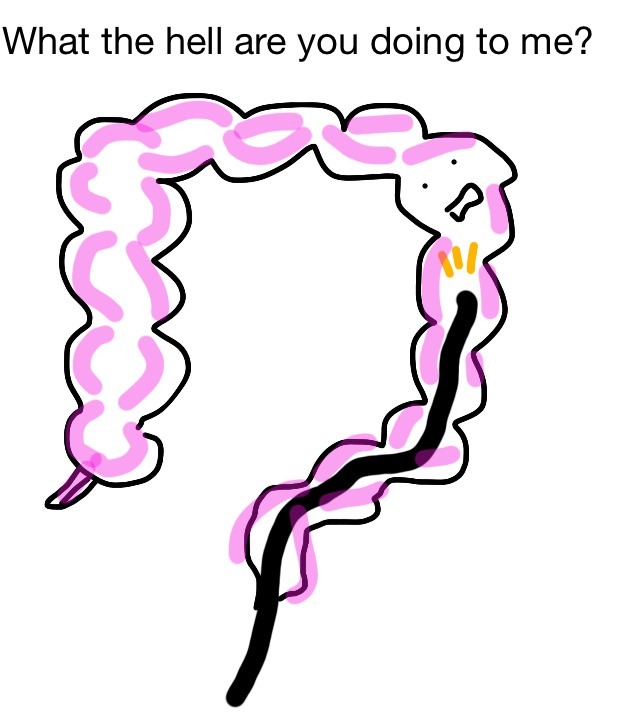
I’m out and in recovery but they want to keep me in overnight – which means at least two nights in hospital – so they can have a go at getting my UC under control. They said my inflammation markers in my blood are up and my colon is very inflamed so clearly my meds either won’t work or will take too long to work (up to three months!) and they don’t want to wait that long.
This does put my colleagues at work under some extra stress as we’re low on staff this week as is and now they are even lower. I hope this doesn’t come back to bite me later but I also realise that my health is way more important than my work.
I’ll try to update as often as I can while I’m here.


 What Can I Eat